With February comes Valentine's Day, and with that come the joys and perils of courtship and romance. During this period, the sharing of gifts and food is just as common as the sharing of affections, and desserts often feature heavily. I fondly remember in particular my ex-flatmate, who, in the run-up to 14th February, made tiramisu repeatedly so that he can perfect his recipe and technique for his then-girlfriend. Needless to say, the entire household benefitted from all the tiramisu prototypes lying around. Given the timing of this post, I thought that it would be appropriate to attempt tiramisu.
One of the key components of tiramisu is Savoiardi biscuits (known as sponge fingers in the UK), soaked in a blend of espresso and Marsala wine. As none of these are available from the Sainsbury's Basics line however, we are going to have to make do with shortbread fingers, instant coffee and brandy.

In a region where people are very serious about their coffee, I've always been surprised that a product like instant coffee can thrive here. Sainsbury's Basics only recently introduced their version of instant coffee very recently, but would be handy to people like the final year medical students in my flat, who are currently studying for their final exams and would probably appreciate preparing a hot caffienated drink for cheap. The coffee itself is nothing yo write home about though, and from a cook's perspective, would be more useful in chilli con carne and stews than in desserts, where the ingredients get more attention.

As noted earlier, Sainsbury's do not have Basics sponge fingers, so I decided to use Shortbread Fingers instead. Other than being similar in shape, they also are richer than most biscuits, and hence share cake-like characteristics with the thing that they replaced.

I was planning to get Basics dark rum in place of Marsala wine, since fermented molasses sounded like a good substitute for sweet wine. However, it appears that Sainsbury's has discontinued both dark and white versions of the Basic rums. An empty shelf with a tag saying "Sale: While stocks last" stands where the white rum used to be. The only other spirit that I know is used in desserts is Brandy, so I grabbed a plastic bottle of the Basics version. Just as well, since in my opinion it is closer in refinement to Marsala wine than rum.

In making this Tiramisu I followed a recipe from the BBC by from the programme Return to Tuscany, with the ingredient substitutions made above, along with Basics soft cheese in place of mascarpone. I also merged it with information from Cooking for Engineers, specifically the part involving making Zabaglione, to avoid food poisoning from consuming raw eggs.
So I started by beating three egg yolks, saving the whites for later. I then added 100g of sugar and about 85ml of the Basics French Brandy.


The mixture was then heated on a hot water bath until thick and smooth. 125g of cream cheese was then beaten and added in.
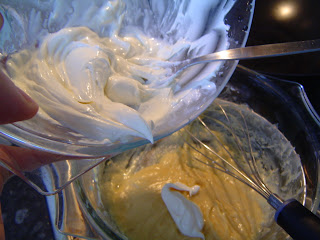

About 125ml (use less if you're attempting this) of double cream was then whipped and added. The mixture was constantly kept warm and whisked frequently until thickened. If the mixture starts becoming lumpy it's being overdone, the result of which you can see in the final photo.
Prepare a cup of coffee using 3 teaspoons of Sainsbury's Basics Instant Coffee, and another 85ml of Brandy. Dip one packet of Basics Shortbread Fingers, biscuit by biscuit, and make them form the first layer. Cover that layer with the cheese/eggs/cream mixture, and repeat for one more layer.


Store in the fridge overnight.

I have very high hopes for this and will write back tomorrow on the outcome. Initial sampling of the cream cheese mixture has been very positive, and the substitution of the ladyfingers and mascarpone has turned out much better than expected. If this works well, this would be a very cheap way to make a very impressive dessert, especially with the soft cheese now costing 75p for a large 300g tub.
(Back to Sainsbury's Basics accepts no responsibility for any adverse effect this recipe or blog post might have on your marriage, engagement or relationship. Use at your own risk.)
One of the key components of tiramisu is Savoiardi biscuits (known as sponge fingers in the UK), soaked in a blend of espresso and Marsala wine. As none of these are available from the Sainsbury's Basics line however, we are going to have to make do with shortbread fingers, instant coffee and brandy.

In a region where people are very serious about their coffee, I've always been surprised that a product like instant coffee can thrive here. Sainsbury's Basics only recently introduced their version of instant coffee very recently, but would be handy to people like the final year medical students in my flat, who are currently studying for their final exams and would probably appreciate preparing a hot caffienated drink for cheap. The coffee itself is nothing yo write home about though, and from a cook's perspective, would be more useful in chilli con carne and stews than in desserts, where the ingredients get more attention.

As noted earlier, Sainsbury's do not have Basics sponge fingers, so I decided to use Shortbread Fingers instead. Other than being similar in shape, they also are richer than most biscuits, and hence share cake-like characteristics with the thing that they replaced.

I was planning to get Basics dark rum in place of Marsala wine, since fermented molasses sounded like a good substitute for sweet wine. However, it appears that Sainsbury's has discontinued both dark and white versions of the Basic rums. An empty shelf with a tag saying "Sale: While stocks last" stands where the white rum used to be. The only other spirit that I know is used in desserts is Brandy, so I grabbed a plastic bottle of the Basics version. Just as well, since in my opinion it is closer in refinement to Marsala wine than rum.

In making this Tiramisu I followed a recipe from the BBC by from the programme Return to Tuscany, with the ingredient substitutions made above, along with Basics soft cheese in place of mascarpone. I also merged it with information from Cooking for Engineers, specifically the part involving making Zabaglione, to avoid food poisoning from consuming raw eggs.
So I started by beating three egg yolks, saving the whites for later. I then added 100g of sugar and about 85ml of the Basics French Brandy.


The mixture was then heated on a hot water bath until thick and smooth. 125g of cream cheese was then beaten and added in.


About 125ml (use less if you're attempting this) of double cream was then whipped and added. The mixture was constantly kept warm and whisked frequently until thickened. If the mixture starts becoming lumpy it's being overdone, the result of which you can see in the final photo.
Prepare a cup of coffee using 3 teaspoons of Sainsbury's Basics Instant Coffee, and another 85ml of Brandy. Dip one packet of Basics Shortbread Fingers, biscuit by biscuit, and make them form the first layer. Cover that layer with the cheese/eggs/cream mixture, and repeat for one more layer.


Store in the fridge overnight.

I have very high hopes for this and will write back tomorrow on the outcome. Initial sampling of the cream cheese mixture has been very positive, and the substitution of the ladyfingers and mascarpone has turned out much better than expected. If this works well, this would be a very cheap way to make a very impressive dessert, especially with the soft cheese now costing 75p for a large 300g tub.
(Back to Sainsbury's Basics accepts no responsibility for any adverse effect this recipe or blog post might have on your marriage, engagement or relationship. Use at your own risk.)
| Description | Price per Unit | No. of servings | Trade-up Premium | Trade-up Benefits |
|---|---|---|---|---|
| Shortbread Fingers | £0.37 | 160g | +£0.31 for 200g | Not known but probably not much |
| Instant Coffee Granules | £1.64 | 100g | +£0.30 | Stronger coffee |
| Brandy | £9.29 | 700ml | +£1.20 | Not known |


