Showing posts with label jam. Show all posts
Sunday, 11 September 2011
Bacon Jam
The Internet is obsessed with bacon. From a Wikipedia project to improve the quality of articles regarding bacon, to YouTube sensation EpicMealTime's permanent feature of bacon in every show they make, it is difficult to deny its pervasiveness in the culture that has built up from a decade or so of the Information Superhighway. About a year or so ago, a colleague of mine mentioned in passing about trying home-made Bacon Jam. Further enquiries revealed that the recipe was taken off the Internet (where else?).
As it turns out, Bacon Jam was created a couple of years ago by Skillet Street Food, a Seattle-based company burger chain which caters to consumers via burger vans. Needless to say, it captured the imagination of the Internet, and the foodie blogger community made various attempts to recreate it from their own kitchens. A Google search places Not Quite Nigella's recipe as its first result, which took inspiration from an earlier recipe by Homesick Texan. Months of procrastination prevented me from following in their footsteps, until two things happened - I acquired a food processor, and Sainsbury's dropped the price of their Basics cooking bacon to £1 for 670g.
There are two problems with buying and using the cooking bacon. One is the packs containing either rashers, or whole hunks of bacon which have not been sliced into rashers. This is easily avoidable by inspecting the packs before buying. The other is that the rashers are clumped together rather than nicely packed like the other bacon products that Sainsbury's has, making them finicky when teasing the rashers apart to put in sandwiches. We can solve this latter problem by making the whole pack into bacon jam.
The process is relatively straightforward and rather fun, and lists amongst its ingredients maple syrup, vinegar, coffee and of course, bacon. People who have completed the recipe have lauded it for its potpourri of flavours, the sweet, sour, bitter, and salty flavours all melding together and boosted by a chilli kick. Excited, I got together the ingredients, including the coffee.
The last time we did a review on the Basics Ground Coffee we went with a rather poor attempt of making a cold brew, so since we had another opportunity to try it, we brewed ourselves a cup. The coffee was pretty smooth and had a nice amount of kick to it, being made from Robusta beans, which have a higher caffeine content compared to the Arabica beans found in most blends. Surprisingly, it was not bitter, which would have been characteristic of Robusta, so Sainsbury's must have adjusted the roasting process to compensate, which kind of shows the amount of detail they put into even Basics products.
The recipe for bacon jam that I used can be found at Not Quite Nigella through the link I have above, so I shall restrict my commentary to the tweaks and other little things I did while making this. For adaptability reasons I have substituted Basics vinegar and honey for cider vinegar and maple syrup respectively. I also added a dried chilli from a pack my flatmate bought in Chinatown to add an extra kick.
The packet of Basics cooking bacon will have to be fried in two stages. If you want to you can also trim the fat off some of the rashers to form a starter batch, which would be rendered of fat in the pan for easier frying of the main bacon batches.
If you do use the starter batch, have it at the side of the pan while frying the bacon so that they can continue to render and become nice and crispy in the process. It is a lot of effort to tease out the bacon rashers before chopping them up, but if you are not planning on using a food processor to grind up the resulting jam later on, you might want to consider doing this if you want a finer-textured jam.
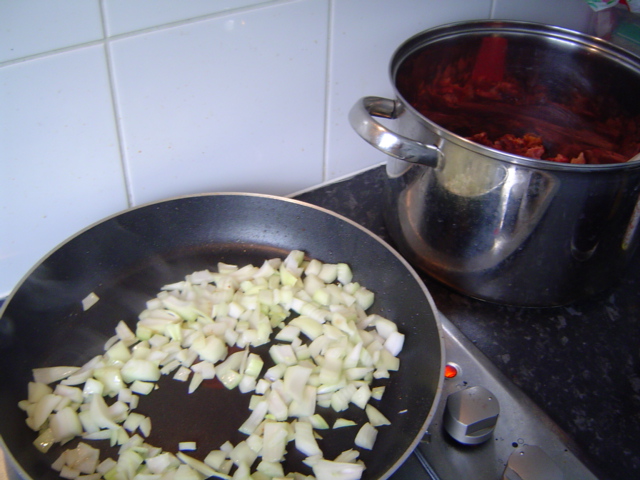
1 hour later, it turns out that I had the heat on too low, so I decided not to add any water at all and crank up the heat to mid so that I can simmer the water away more quickly. Unfortunately, 2 hours from the time I started simmering, I am nowhere near the nice dark colour that Not Quite Nigella managed to get.
On the 3rd hour however...
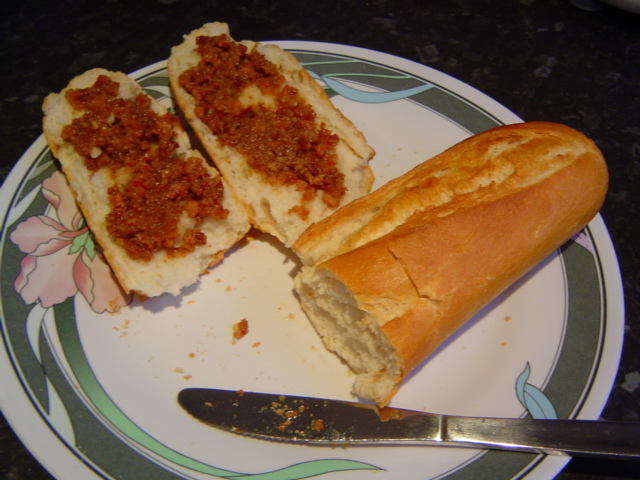
Satisfied with progress, I turned off the heat on the stove to let it cool slowly. After that, a brief spin in the food processor, and the bacon jam was ready to be spread on Sainsbury's Basics Baguette.
This was a resounding success. The bacon jam, effectively a pate, tastes great, if perhaps a little too sweet and oily, and will go well with anything that usually calls for bacon. Already I'm thinking of not just spreading this on my bread, but taking up the suggestions floating around on the Net and putting it into pastas, serving it with poached eggs, and perhaps even with asparagus, if it happens to be cheap. I might have to work out a way to not make it feel so oily, perhaps by leaving out some of the liquid from the cooking, or patting the bacon dry with kitchen towels before transferring to the pot. This recipe will nonetheless be a godsend to anybody in university who might love bacon, but want to have it cheaply, and without the fuss of carefully peeling apart randomly mashed rashers at 8.30 in the morning, half an hour before the first lecture of the day.
Sunday, 26 June 2011
Char Siew - Chinese BBQ pork
I miss home. I miss being able to roam out for dinner, scouring the food court for good cheap fare. If there's anything my stay here has taught me however, it's that a lot of the food that I and many others miss can be replicated to varying degrees of success. One which I have not seen done too often though is char siew - Chinese BBQ pork. Typically, the meat is marinated in a sweet sauce made of various ingredients, including honey, hoisin sauce and rice wine, amongst others, before being roasted, all the while being basted with the same sweet sauce. The process is pretty involved, which given the timetable constraints faced by most university students, might explain why I never saw my friends try this at home.
Curiosity got the better of me however, and when I came across the Sainsbury's Basics Pork Shoulder Joint, I knew I had to try it, somehow. If anything, I guess to the British readers who form the majority of my reading audience it might be an interesting variation on the traditional pork roast.
In coming up with a recipe for char siew I made use of two references. The recipe itself was by and large taken with slight modifications given what I had to hand in my kitchen from Jacqui Tezyk's Recipe Quest, a forum where recipes are shared between members. I used this as it featured marmalade, which piqued my curiosity; perhaps the author is also based away from home and had to improvise. The cooking technique from Rasa Malaysia was used as it appeared to be more suitable for cooking large joints of meat similar to what I bought.
Combine the following for 1.4kg of meat:
Soak the meat in the marinade overnight, draining all fluid from the pork before putting into the bowl. If you made a mistake like me and had the fluid in the bowl, set it up as follows, damming the marinade up, assuming the bowl is that small.
The following day, preheat the oven to 220 degrees Celsius. Shake off excess marinade from the pork before transferring to a roasting pan.
To calculate the amount of time needed for roasting, for every 500g of pork, add 45 minutes, and on top of all that add an additional 20 minutes. After 30 minutes, reduce the temperature of the oven to 160 degrees Celsius. Reduce the excess marinade that you may have, and one hour before the roast is due to be done, take out of the oven and coat with the reduction.
It's a pity that I burnt the skin of the pork, as it would probably have been one of the tastiest parts of the joint. I'm supposed to bring this for my bible study group session on Tuesday evening, but I have had a taste of the reduced marinade and have found it to be close enough to the taste of char siew that I'm familiar with. Not sure how much the marmalade actually contributed though.
Curiosity got the better of me however, and when I came across the Sainsbury's Basics Pork Shoulder Joint, I knew I had to try it, somehow. If anything, I guess to the British readers who form the majority of my reading audience it might be an interesting variation on the traditional pork roast.
In coming up with a recipe for char siew I made use of two references. The recipe itself was by and large taken with slight modifications given what I had to hand in my kitchen from Jacqui Tezyk's Recipe Quest, a forum where recipes are shared between members. I used this as it featured marmalade, which piqued my curiosity; perhaps the author is also based away from home and had to improvise. The cooking technique from Rasa Malaysia was used as it appeared to be more suitable for cooking large joints of meat similar to what I bought.
Combine the following for 1.4kg of meat:
- 2 tablespoons marmalade
- 4 tablespoons oyster sauce
- 4 cloves garlic, crushed and finely chopped
- 8 tablespoons light soya sauce
- 2 tablespoon dark soya sauce
- 3 tablespoons honey
Soak the meat in the marinade overnight, draining all fluid from the pork before putting into the bowl. If you made a mistake like me and had the fluid in the bowl, set it up as follows, damming the marinade up, assuming the bowl is that small.
The following day, preheat the oven to 220 degrees Celsius. Shake off excess marinade from the pork before transferring to a roasting pan.
To calculate the amount of time needed for roasting, for every 500g of pork, add 45 minutes, and on top of all that add an additional 20 minutes. After 30 minutes, reduce the temperature of the oven to 160 degrees Celsius. Reduce the excess marinade that you may have, and one hour before the roast is due to be done, take out of the oven and coat with the reduction.
It's a pity that I burnt the skin of the pork, as it would probably have been one of the tastiest parts of the joint. I'm supposed to bring this for my bible study group session on Tuesday evening, but I have had a taste of the reduced marinade and have found it to be close enough to the taste of char siew that I'm familiar with. Not sure how much the marmalade actually contributed though.
| Description | Price per Unit | No. of servings | Trade-up Premium | Trade-up Benefits |
|---|---|---|---|---|
| Medium-cut Marmalade | £0.30 | 454g | +£0.61 | Choice of cut, higher fruit content |
| Boneless Pork Shoulder | £2.99/kg | by weight | +£2.00/kg | Not known, better pork quality? |
Sunday, 12 June 2011
Home-made Jaffa Cakes
If there is anything that I would miss when I go back home, it's Jaffa Cakes. Apparently I'm not alone too; while browsing on the web, I have come across many people outside of the UK who laments the lack of availability of the incredible chocolate-topped snack cake with an orangey centre. Or if they're available, that they're not affordable. Already I get regular complaints from readers who came to the UK for studies and have since gone back to their respective hometowns about not being able to get their Jaffa Cake fix, and that efforts to try to get their local distributor for McVities products to import the snack have proven in vain.
The next best thing then, is to make the cakes from scratch. A quick Google search reveals that the Jaffa cake is nothing more than a low-fat sponge topped with some gelatinous substance before the entire top is coated with chocolate. The difficult bit is trying to find the low-fat sponge recipe, which wasn't too difficult; that information came along with the jaffa cake recipe search. Which leaves us with the fun stuff - the chocolate coating and the jelly-like centre.
Some recipes I've come across call for proper jelly to be in the centre, but others have commented that marmalade would suffice. I gambled and just used Sainsbury's Basics Orange Marmalade, and found it to suffice. Since it's medium cut, there would be a fair bit of rind and other bits suspended in the spread, which might annoy some. Personally, I think it provides for some interesting texture.
So start by making the low-fat sponge. Beat one egg together with 50g of caster sugar until fluffy. Add 50g of plain flour and keep beating until a smooth batter is obtained.
Grease a muffin tin, and add the batter to the tin holes. It should be good enough for six cakes, so scale the recipe as desired.
Bake at 180 degrees Centigrade for about 8-10 minutes.
Melt some Sainsbury's Basics chocolate either in a double boiler or a microwave set on high for two minutes. I went with milk chocolate as I felt that some contrast was needed against the slightly bitter and sour Basics marmalade.
Put a small teaspoon of marmalade in the centre of each cake, before applying a coat of chocolate over the top. Adjust thickness of coating to taste.
Leave to cool before transferring to fridge to let the chocolate set.
I overdid the coating, such that it overpowered the marmalade and made the cake stodgy overall. Had that gone well though, the cakes would have made for a really great light snack. It's also good to know that the joy of eating Jaffa Cakes is also no longer restricted to places which sell them, since the recipe is pretty easy to reproduce at home.
The next best thing then, is to make the cakes from scratch. A quick Google search reveals that the Jaffa cake is nothing more than a low-fat sponge topped with some gelatinous substance before the entire top is coated with chocolate. The difficult bit is trying to find the low-fat sponge recipe, which wasn't too difficult; that information came along with the jaffa cake recipe search. Which leaves us with the fun stuff - the chocolate coating and the jelly-like centre.
Some recipes I've come across call for proper jelly to be in the centre, but others have commented that marmalade would suffice. I gambled and just used Sainsbury's Basics Orange Marmalade, and found it to suffice. Since it's medium cut, there would be a fair bit of rind and other bits suspended in the spread, which might annoy some. Personally, I think it provides for some interesting texture.
So start by making the low-fat sponge. Beat one egg together with 50g of caster sugar until fluffy. Add 50g of plain flour and keep beating until a smooth batter is obtained.
Grease a muffin tin, and add the batter to the tin holes. It should be good enough for six cakes, so scale the recipe as desired.
Bake at 180 degrees Centigrade for about 8-10 minutes.
Melt some Sainsbury's Basics chocolate either in a double boiler or a microwave set on high for two minutes. I went with milk chocolate as I felt that some contrast was needed against the slightly bitter and sour Basics marmalade.
Put a small teaspoon of marmalade in the centre of each cake, before applying a coat of chocolate over the top. Adjust thickness of coating to taste.
Leave to cool before transferring to fridge to let the chocolate set.
I overdid the coating, such that it overpowered the marmalade and made the cake stodgy overall. Had that gone well though, the cakes would have made for a really great light snack. It's also good to know that the joy of eating Jaffa Cakes is also no longer restricted to places which sell them, since the recipe is pretty easy to reproduce at home.
| Description | Price per Unit | No. of servings | Trade-up Premium | Trade-up Benefits |
|---|---|---|---|---|
| Medium-cut Marmalade | £0.30 | 454 | +£0.61 | Choice of cut, higher fruit content |
Saturday, 23 April 2011
Peanut Butter Jelly Bread
I am going for a trip to the States over the Easter break, so to mark the occasion I decided to make something for the charity bake sale at work. I happened to have Linda Larsen's Everything Meals on a Budget Cookbook handy, so I decided to leaf through it to find something cost-effective to make and yet distinctly American.
Sure enough, there was something which fit the bill. The book had a recipe for peanut butter bread, described as a good and cheap source of protein and carbohydrayes, lending itself to a cost-effective breakfast. To make things even more American, I made use of the Basics strawberry jam I had remaining in the fridge as the jelly part of today's post; what they refer to as "jelly" is actually fruit preserve without seeds. I made a few tweaks to the recipe to simplify the ingredidnts list. I started with a jar of Basics peanut butter, combined with brown sugar (250g, though I used half of that), and three eggs.
In another bowl, combine about 500g Basics plain flour with bicarbonate of soda and half a teaspoon of salt. Mix this into the peanut butter mixture alternately with 250ml of milk.
Pour the resulting mixture into a tray lined with greaseproof paper. Dribble Basics strawberry jam onto surface, and use a knife to work through it, creating a marble effect.
Bake at 180 degrees Celsius until you can dip a toothpick in and out of it cleanly.
The initial impression left on the bake sale organisers was very good: I suppose it was due to the visual appeal of the final product. A colleague of mine also had the chance to try it, and while the taste wasn't memorable due to my messing up the proportions, at least she didn't fall ill.
Sure enough, there was something which fit the bill. The book had a recipe for peanut butter bread, described as a good and cheap source of protein and carbohydrayes, lending itself to a cost-effective breakfast. To make things even more American, I made use of the Basics strawberry jam I had remaining in the fridge as the jelly part of today's post; what they refer to as "jelly" is actually fruit preserve without seeds. I made a few tweaks to the recipe to simplify the ingredidnts list. I started with a jar of Basics peanut butter, combined with brown sugar (250g, though I used half of that), and three eggs.
In another bowl, combine about 500g Basics plain flour with bicarbonate of soda and half a teaspoon of salt. Mix this into the peanut butter mixture alternately with 250ml of milk.
Pour the resulting mixture into a tray lined with greaseproof paper. Dribble Basics strawberry jam onto surface, and use a knife to work through it, creating a marble effect.
Bake at 180 degrees Celsius until you can dip a toothpick in and out of it cleanly.
The initial impression left on the bake sale organisers was very good: I suppose it was due to the visual appeal of the final product. A colleague of mine also had the chance to try it, and while the taste wasn't memorable due to my messing up the proportions, at least she didn't fall ill.
Labels:
bread,
dessert,
flour,
jam,
Linda Larsen,
peanut butter,
snack
Saturday, 2 April 2011
Strawberry Lamb Roast
I have a jar of Basics strawberry jam that has been sitting in the fridge for quite some time and have been looking for a way to get rid of it. A few weeks ago my friend actually suggested strawberry lamb. I recoiled in horror until she revealed that she has already tried it herself, putting roast lamb with jam and other condiments in sandwiches. The more I thought about it, and the more I researched on the Internet, the more it sounded like a nice idea.
I have come across recipes involving the combination of mint, strawberries and pepper in various permutations, and while not personally keen on the idea, have heard people rave about it. Effectively, you combine that with the ingredients for a spritzer (see above), and use it as a lamb marinade. This sounded like a great adventure. I get to try new tastes, and I also get to muck around with alcohol-based marinades. Other than a chance for a decent meal, I don't have much to lose..
The lamb has to be prepared 24 hours in advance, to allow for time to marinade. Begin by slicing onions and lemons and adding to a bowl.
Add the lamb, and about two and a half tablespoons of strawberry jam. Season with Basics pepper, and Sainsbury's Mint, or Sainsbury's Basics Mint sauce.
Add a glass of Basics rose wine, and marinate for 24 hours. Place on aluminium foil and roast in oven for 2.5 hours at 180 degrees Celsius.
While the lamb is in the oven, reduce the leftover marinate by about half. Take the lamb out of the oven, cover with the reduction, and return it, leaving it there for the remaining time.
While the lamb tasted good, I think the strawberry marinade did not manage to permeate beyond the surface of the roast. In addition, the roast was very fatty; I can see why not everybody sees this as a good cut of meat. Still, it's very cheap - even cheaper if sourced from a local butcher - so if I can find an open roasting spit or something or other that would allow the fat to drip away that would be great. An open fire could even plausibly be fed by the melting fat to sustain itself.
| Description | Price per Unit | No. of servings | Trade-up Premium | Trade-up Benefits |
|---|---|---|---|---|
| Rosé Wine | £2.85 | 750ml | +£variable | Many |
| Lemons | £0.87 | 4 | +£0.63 for 5 | More consistently sized lemons |
Sunday, 9 January 2011
White Chocolate and Strawberry Marble Cheesecake
About five months ago I bought this tube of Sainsbury's Basics Digestive Biscuits from a Sainsbury's Local. I needed to get cashback from the till as all the nearby ATMs were busy or nonfunctional, and the biscuits were very cheap at 23p. I figured that at some point in the future I will get round to using this to making a cheesecake, since this is perhaps the only kind of recipe I know that involves digestive biscuits. Now with less than a week to go on its expiry date, it was time to get cracking.
The biscuits themselves are smaller in size compared to say, McVitie's Digestives, and seem to crumble more easily. Probably would not make them suitable for dunking, quite contrary to what the label suggests. However, since they seem to taste quite similar to McVitie's, they would be great for making cheesecake bases with.
The recipe I have in mind for today is one found in Todd Wilbur's Top Secret Recipes, where he attempts to mimic the White Chocolate and Raspberry Truffle Cheesecake at The Cheesecake Factory. In it, he dots the top of the cheesecake with slightly diluted raspberry preserve, before using a knife to create a beautiful raspberry swirl pattern. I could do something similar with my Sainsbury's Basics Strawberry Jam, and in so doing run down my Basics inventory.
Microwave 25-50g of butter until it liquefies. Add 100g of Sainsbury's Basics digestives (about a quarter of the packet) and smash everything up until you get a butter crumb mixture.
Press the butter-crumb mixture firmly into the base of a cake tin. Refrigerate until ready to use.
While waiting for the base to set, combine 75g of caster sugar, one packet of Sainsbury's Basics cream cheese and an egg in a bowl.
Break up a bar of Sainsbury's Basics White Chocolate without opening the packet, using a hard object to further pulverise if necessary. Open the packet and dump contents into the cheese mixture before mixing thoroughly.
Now, take the butter-crumb base out of the fridge and pour the cheese mixture on top. In another bowl, add about 1 tsp of water (not 1.5 tbsp as I have inadvertently done) to about one tablespoon of Sainsbury's Basics Strawberry Jam and microwave on high for about 10 seconds. Stir into a thick sauce, and then drip a few dots onto the surface of the cheesecake. Use a knife or similar tool to 'connect the dots', resulting in the marble effect you partially see here.
Bake in oven at 170 degrees Celsius for about 30-35 minutes until the centre is just set and the edges are firm. Turn off oven and leave to cool in there for another 2 hours before transferring to the fridge to set overnight.
I will be taking this to my workplace tomorrow for my colleagues to have a sample, since they are always entertained by the work I do here. I will try to get them to comment on this post so that you will have an idea of how good (or bad!) it is.
| Description | Price per Unit | No. of servings | Trade-up Premium | Trade-up Benefits |
|---|---|---|---|---|
| Digestive Biscuits | £0.23 | 400g | +£0.60 for 500g (McVities) | The real deal. Recommended. |
Monday, 16 August 2010
Strawberry and Brie Baguette
To be honest, I bought the Basics Brie not only because I wanted to make cheesesteak, but also because I came across an interesting article on my RSS news reader about somebody who tried making a Raspberry and Brie panini. Long story short, it convinced her to buy a panini maker.
By my books, if a recipe can persuade a person to buy expensive kitchen equipment, it has got to be pretty good, or even one step away from life-changing (after all, that eqiupment is going to affect the person's kitchen habits one way or another). The problem though is that I had to make do with the Sainsbury's Basics Strawberry Jam since their range is so limited. On the other hand, strawberries are nothing like raspberries, for a start, the latter tend to be quite tart. If memory serves, the writer of the panini article was waxing lyrical about how the smoothness of the brie contrasted perfectly with the raspberry.
Given how sweet the Basics jam is however, I don't really see this happening. The fruit content is pretty low too, so it might feel as if I'm just eating melted sugar jelly. Yet at the same time, I was really curious as to how the combination would turn out, so without much hesitation, I put bits of Brie on one side of the other baguette half, spread jam on the other, and grilled for a while.
The sandwich was actually quite pleasant, almost like a cross between a Victoria Sponge and a strawberry cheesecake all wrapped in crusty coating. It might be a welcome lunch alternative, especially to those who have a sweet tooth.
By my books, if a recipe can persuade a person to buy expensive kitchen equipment, it has got to be pretty good, or even one step away from life-changing (after all, that eqiupment is going to affect the person's kitchen habits one way or another). The problem though is that I had to make do with the Sainsbury's Basics Strawberry Jam since their range is so limited. On the other hand, strawberries are nothing like raspberries, for a start, the latter tend to be quite tart. If memory serves, the writer of the panini article was waxing lyrical about how the smoothness of the brie contrasted perfectly with the raspberry.
Given how sweet the Basics jam is however, I don't really see this happening. The fruit content is pretty low too, so it might feel as if I'm just eating melted sugar jelly. Yet at the same time, I was really curious as to how the combination would turn out, so without much hesitation, I put bits of Brie on one side of the other baguette half, spread jam on the other, and grilled for a while.
The sandwich was actually quite pleasant, almost like a cross between a Victoria Sponge and a strawberry cheesecake all wrapped in crusty coating. It might be a welcome lunch alternative, especially to those who have a sweet tooth.
Description | Price per Unit | No. of servings | Trade-up Premium | Trade-up Benefits |
|---|---|---|---|---|
| French Mild Brie | £0.95 | 200g | +£0.84 for 300g | Better-tasting Brie, choice between French Mild, French ripening or Somerset (prices may differ) |
| Strawberry Jam | £0.38 | 454g | +£0.60 | Higher fruit content, reduced sugar option |
Subscribe to:
Posts (Atom)