Showing posts with label honey. Show all posts
Sunday, 11 September 2011
Bacon Jam
The Internet is obsessed with bacon. From a Wikipedia project to improve the quality of articles regarding bacon, to YouTube sensation EpicMealTime's permanent feature of bacon in every show they make, it is difficult to deny its pervasiveness in the culture that has built up from a decade or so of the Information Superhighway. About a year or so ago, a colleague of mine mentioned in passing about trying home-made Bacon Jam. Further enquiries revealed that the recipe was taken off the Internet (where else?).
As it turns out, Bacon Jam was created a couple of years ago by Skillet Street Food, a Seattle-based company burger chain which caters to consumers via burger vans. Needless to say, it captured the imagination of the Internet, and the foodie blogger community made various attempts to recreate it from their own kitchens. A Google search places Not Quite Nigella's recipe as its first result, which took inspiration from an earlier recipe by Homesick Texan. Months of procrastination prevented me from following in their footsteps, until two things happened - I acquired a food processor, and Sainsbury's dropped the price of their Basics cooking bacon to £1 for 670g.
There are two problems with buying and using the cooking bacon. One is the packs containing either rashers, or whole hunks of bacon which have not been sliced into rashers. This is easily avoidable by inspecting the packs before buying. The other is that the rashers are clumped together rather than nicely packed like the other bacon products that Sainsbury's has, making them finicky when teasing the rashers apart to put in sandwiches. We can solve this latter problem by making the whole pack into bacon jam.
The process is relatively straightforward and rather fun, and lists amongst its ingredients maple syrup, vinegar, coffee and of course, bacon. People who have completed the recipe have lauded it for its potpourri of flavours, the sweet, sour, bitter, and salty flavours all melding together and boosted by a chilli kick. Excited, I got together the ingredients, including the coffee.
The last time we did a review on the Basics Ground Coffee we went with a rather poor attempt of making a cold brew, so since we had another opportunity to try it, we brewed ourselves a cup. The coffee was pretty smooth and had a nice amount of kick to it, being made from Robusta beans, which have a higher caffeine content compared to the Arabica beans found in most blends. Surprisingly, it was not bitter, which would have been characteristic of Robusta, so Sainsbury's must have adjusted the roasting process to compensate, which kind of shows the amount of detail they put into even Basics products.
The recipe for bacon jam that I used can be found at Not Quite Nigella through the link I have above, so I shall restrict my commentary to the tweaks and other little things I did while making this. For adaptability reasons I have substituted Basics vinegar and honey for cider vinegar and maple syrup respectively. I also added a dried chilli from a pack my flatmate bought in Chinatown to add an extra kick.
The packet of Basics cooking bacon will have to be fried in two stages. If you want to you can also trim the fat off some of the rashers to form a starter batch, which would be rendered of fat in the pan for easier frying of the main bacon batches.
If you do use the starter batch, have it at the side of the pan while frying the bacon so that they can continue to render and become nice and crispy in the process. It is a lot of effort to tease out the bacon rashers before chopping them up, but if you are not planning on using a food processor to grind up the resulting jam later on, you might want to consider doing this if you want a finer-textured jam.
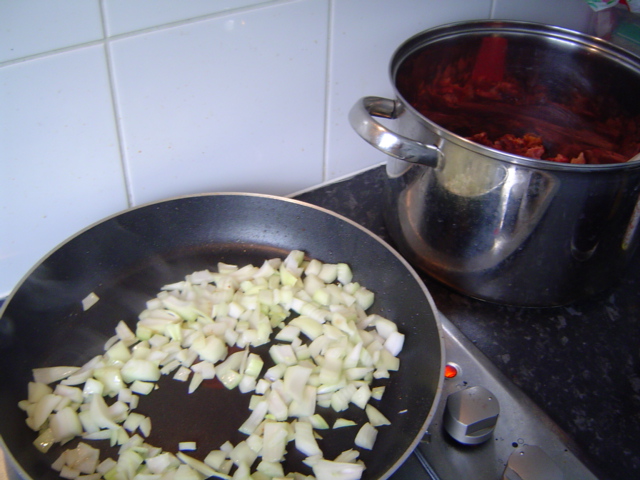
1 hour later, it turns out that I had the heat on too low, so I decided not to add any water at all and crank up the heat to mid so that I can simmer the water away more quickly. Unfortunately, 2 hours from the time I started simmering, I am nowhere near the nice dark colour that Not Quite Nigella managed to get.
On the 3rd hour however...
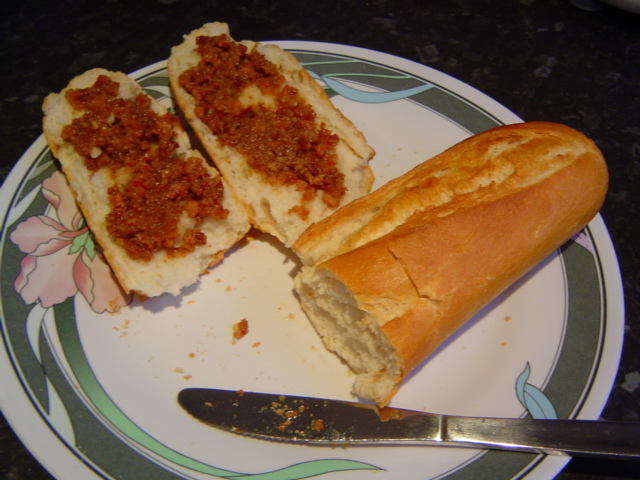
Satisfied with progress, I turned off the heat on the stove to let it cool slowly. After that, a brief spin in the food processor, and the bacon jam was ready to be spread on Sainsbury's Basics Baguette.
This was a resounding success. The bacon jam, effectively a pate, tastes great, if perhaps a little too sweet and oily, and will go well with anything that usually calls for bacon. Already I'm thinking of not just spreading this on my bread, but taking up the suggestions floating around on the Net and putting it into pastas, serving it with poached eggs, and perhaps even with asparagus, if it happens to be cheap. I might have to work out a way to not make it feel so oily, perhaps by leaving out some of the liquid from the cooking, or patting the bacon dry with kitchen towels before transferring to the pot. This recipe will nonetheless be a godsend to anybody in university who might love bacon, but want to have it cheaply, and without the fuss of carefully peeling apart randomly mashed rashers at 8.30 in the morning, half an hour before the first lecture of the day.
Sunday, 19 June 2011
Honey Beer Cake
It has been a while since my trip to the States. While I was there I have had the privilege to get to meet my counterparts at work and people who like me have left our home country to be overseas. While staying over at one of theirs I came across Booze Cakes, a cookbook dedicated to making cakes using alcohol. While this might raise a few eyebrows in the UK, this is perhaps considered normal amongst Americans. In any case, within the book was a recipe that would come in useful in running down my leftover Basics lager, while also providing the British another way to enjoy what is by far their most popular form of alcohol - beer.
I have decided to make a few changes to the recipe found in the book, adding Sainsbury's Basics sultanas. Having never tried these sultanas before I cannot offer much information on them, so I went to do a bit of research. It appears that sultanas actually refer more to a grape variety, although they are nowadays commonly accepted to be the raisin derived from the grape. Known for their sweetness, sultanas are also also known as the threeway grape to their triple use in winemaking, raisins, and being served as table grapes. In light of this information perhaps a future feature on wine cake might be appropriate.
But for now, let's begin. Mix together 430g of Basics plain flour with about 3 teaspoons of Bicarbonate of Soda, a bit of salt and some cinnamon, and set aside.
Cream one stick of Sainsbury's Basics butter and sugar until fluffy. Add four eggs before adding 10 tablespoons of Basics honey.
Pour in the flour mixture and beer, alternating between the two. Fold in the sultanas and bake at 165 degrees Celsius for 45 minutes, or until a knife can be cleanly inserted and taken out.
Please don't do as I have done and use the Pyrex bowl that you mixed the cake batter in for baking. Transfer the lot into a shallow tray instead, to allow the cake to cook quicker. It also helps with the washing up as the cooked cake batter on the surface around the inside of the bowl is now harder to remove.
I have decided to make a few changes to the recipe found in the book, adding Sainsbury's Basics sultanas. Having never tried these sultanas before I cannot offer much information on them, so I went to do a bit of research. It appears that sultanas actually refer more to a grape variety, although they are nowadays commonly accepted to be the raisin derived from the grape. Known for their sweetness, sultanas are also also known as the threeway grape to their triple use in winemaking, raisins, and being served as table grapes. In light of this information perhaps a future feature on wine cake might be appropriate.
But for now, let's begin. Mix together 430g of Basics plain flour with about 3 teaspoons of Bicarbonate of Soda, a bit of salt and some cinnamon, and set aside.
Cream one stick of Sainsbury's Basics butter and sugar until fluffy. Add four eggs before adding 10 tablespoons of Basics honey.
Pour in the flour mixture and beer, alternating between the two. Fold in the sultanas and bake at 165 degrees Celsius for 45 minutes, or until a knife can be cleanly inserted and taken out.
Please don't do as I have done and use the Pyrex bowl that you mixed the cake batter in for baking. Transfer the lot into a shallow tray instead, to allow the cake to cook quicker. It also helps with the washing up as the cooked cake batter on the surface around the inside of the bowl is now harder to remove.
| Description | Price per Unit | No. of servings | Trade-up Premium | Trade-up Benefits |
|---|---|---|---|---|
| Sultanas | £0.99 | 500g | +£0.55 | Not known |
Saturday, 7 November 2009
Cider-battered Sweet and Sour Pork
In the aftermath of the cider yoghurt cake, I now have about 1.5 litres of unwanted cider sitting in my kitchen, along with other odds and ends that I have used in previous installments of this blog. We also happen to have too many Basics eggs in our kitchen, that we have to rid ourselves of by the 25th of November. It occurred to me however that we have most of the ingredients to actually make sweet and sour pork. What was missing was the pork itself.
You might hence be happy to know that £2 would buy you about half a kilogramme of pork, 445g to be precise, the kind ideal for making bite-sized deep-fried pork cutlets. The closest that Sainsbury's has to a regular product would be the pork shoulder steaks, but you would have to cut those up yourself. The diced pork shoulder however should suffice for most purposes. It did not get tough too easily, and tasted pretty alright. At only £2 it's only slightly more expensive per unit weight compared to the Basics lamb breast - itself the cheapest red meat - but is a lot less fatty.

Since here in the UK roast pork is usually served with apple sauce, and we get beer-battered fish and chips, I thought it might be interesting to come up with a cider batter for the pork in homage to my current state of residence. I would then combine this with a sweet and sour sauce made from what's left of my pasta sauce, honey, vinegar and mixed vegetables.
Start by heating oil in a saucepan at medium-high heat. Meanwhile, combine self-raising flour with an egg.
Season with pepper, and then add the cider. Care should be taken not to add too much cider to the mix, you still want to have a relatively thick batter that has the consistency of double cream.

Once batter has been thoroughly whisked, open up the packet of pork, and dust the pork pieces with flour. You might have to further cut up some of them to facilitate more thorough cooking.
Dip each piece in batter, and begin frying.

Put cooked pieces on a paper-lined plate to drain of excess oil.
The sauce is a relatively simple affair of combining some honey, vinegar and tomato pasta sauce. Frozen mixed vegetables are added in the absence of the more traditional fresh sliced pineapple, peppers, onions and tomatoes.
After saving the deep-frying oil for future cooking, scrape the pan clean of any leftover bits. Deglaze the pan by adding the vinegar and heating.
Meanwhile, add the honey to the pasta sauce, and add that into the pan.

At this point add the mixed vegetables. It might be tempting to use some of the excess batter to thicken the sauce. Don't be fooled, you will end up with the result below:


The cider was weak to begin with, so it never really shone through the resulting dinner. The sauce was more or less palatable. Overall, dinner was rather enjoyable, and at the very least, I've gained some useful experience with deep-frying that would probably serve me well when making tempura.
You might hence be happy to know that £2 would buy you about half a kilogramme of pork, 445g to be precise, the kind ideal for making bite-sized deep-fried pork cutlets. The closest that Sainsbury's has to a regular product would be the pork shoulder steaks, but you would have to cut those up yourself. The diced pork shoulder however should suffice for most purposes. It did not get tough too easily, and tasted pretty alright. At only £2 it's only slightly more expensive per unit weight compared to the Basics lamb breast - itself the cheapest red meat - but is a lot less fatty.
Since here in the UK roast pork is usually served with apple sauce, and we get beer-battered fish and chips, I thought it might be interesting to come up with a cider batter for the pork in homage to my current state of residence. I would then combine this with a sweet and sour sauce made from what's left of my pasta sauce, honey, vinegar and mixed vegetables.
The cider was weak to begin with, so it never really shone through the resulting dinner. The sauce was more or less palatable. Overall, dinner was rather enjoyable, and at the very least, I've gained some useful experience with deep-frying that would probably serve me well when making tempura.
| Description | Price per Unit | No. of servings | Trade-up Premium | Trade-up Benefits |
|---|---|---|---|---|
| Diced pork shoulder | £2.00 | 445g | N/A | N/A; No other alternative |
Thursday, 5 November 2009
Cider Yoghurt Cake
Yoghurt cake is apparently a very British thing, with some web sites noting that they are quite prevalent amongst British-run chalets. Essentially it substitutes yoghurt and oil for milk and butter in a cake, with the other main components of flour, sugar and eggs kept. The recipes available on the Internet are all very simple to follow, and effectively give ingredient quantities in ratios.
I was first introduced to it a few years ago by a friend of mine, who made it for our Bible fellowship group. More recently I've had grown tired of eating yoghurt and mixed fruit for breakfast, and considered this to be a quick way to rid myself of those things. Today's post however is a complete failure, largely because I have forgotten to include eggs, the most basic of ingredients in a cake. What I wound up with instead seemed to resemble some sort of hard scone. Either way, this is not going to stop me from blogging about the experience.
The point of this blog after all is more to introduce you to the Basics food range than it is for me to display my cooking proficiency after all. So we start off with the self-raising flour, which would be needed in most cake recipes. I did not notice too much problems with the self-raising flour, although the resulting cake did not rise as much as I thought it would. This may either be due to my accidental exclusion of eggs (refer to further comment at the end of the blog), or the possibility that the flour does not contain enough yeast.

I had wanted to add a bit of an interesting twist to the cake, so I decided to use cider. Not too long ago Sainsbury's was mired in a bit of controversy involving their Basics cider. In addition to being sold in 2 litre bottles, they were also sold in cans, with each can costing 34p. Naturally, they were a cheap source of alcohol, and took a lot of heat for aggravating the UK's problem with drink. The cans were hence taken off, and as a result, I would have to work out how to dispose of the rest of the cider. Do not bother buying this, it is almost indistinguishable from water.
We don't wish to have all that cider sloshing around in our cake mix, so start by bringing 300-500 ml of cider to the boil, aiming to reduce it by two-thirds.

Meanwhile, put your yoghurt into a bowl.
Add 3 parts flour....

... 1 part oil...
... and 2 parts sugar, or in my case, 1 part honey. At this point, remember to add 2 eggs. Once that is done, proceed with the rest of the recipe and add your dried mixed fruit.

Given that the Basics cider tasted horrible, I hedged my bets and divided my cake mixture into two separate tins. Remember to grease them before pouring in the mix. The one on the right contains the reduced cider.
Bake at 200 degrees Celsius for about 10-15 minutes, checking that it has turned a golden brown during the specified window.


The end result was palatable. It would probably have risen up much more had I added the eggs; they're necessary to store trapped air within its protein structure for the yeast in the self-raising flour to work on, and as the oven heats up, the cake rises.
I was first introduced to it a few years ago by a friend of mine, who made it for our Bible fellowship group. More recently I've had grown tired of eating yoghurt and mixed fruit for breakfast, and considered this to be a quick way to rid myself of those things. Today's post however is a complete failure, largely because I have forgotten to include eggs, the most basic of ingredients in a cake. What I wound up with instead seemed to resemble some sort of hard scone. Either way, this is not going to stop me from blogging about the experience.
The point of this blog after all is more to introduce you to the Basics food range than it is for me to display my cooking proficiency after all. So we start off with the self-raising flour, which would be needed in most cake recipes. I did not notice too much problems with the self-raising flour, although the resulting cake did not rise as much as I thought it would. This may either be due to my accidental exclusion of eggs (refer to further comment at the end of the blog), or the possibility that the flour does not contain enough yeast.
| Description | Price per Unit | No. of servings | Trade-up Premium | Trade-up Benefits |
|---|---|---|---|---|
| Self-raising flour | £0.43 | 1.5kg | +£0.32 | Flour that rises better? |
| Cider | £1.21 | 2L | +£1.57 for 3L | Better tasting cider. Recommended |
Monday, 31 August 2009
Crepes
A feature of BBC's Economy Gastronomy sees the featured family attempting to replicate something they would usually get from takeaways or eating out. The first episode had fried chicken, the second chocolate brownie biscuits, and the third, Indian curry. Typically, they save at least 50% of the money they would otherwise spend buying it ready-made.
We here at Ekonomi Gastronomi love crepes. There's an excellent creperie near where we study that has been visited by many a celebrity, and students with extra change. However, prices are expensive, anywhere between £3 to £8.50, so for today we shall demonstrate and attempt to make our own crepes.

The only problem was sourcing for ingredients. The team did not want to invest in 1.5kg of Basics flour that nobody would be using in future. So the 8p bag of pancake batter mix was a godsend. It consists of nothing more than plain flour, skimmed milk powder and a pinch of salt. All that had to be added was an egg, 250ml of water, and a tablespoon of oil, before whisking till smooth.

I decided on a savoury crepe and a sweet crepe. The sweet crepe would be honey and peanut butter, while the savoury one is ham and cheese, with added mixed herbs and black pepper.


The total cost for both crepes comes up to:
8p for the mix, 10p for 2 slices of ham, 10p for the cheese, 10p for an egg, and about 10p for both the honey and the peanut butter (although of course, the initial outlay for both jars would be much higher), bringing it to a total of 48p for the entire lunch. If memory serves, an equivalent sweet crepe costs £3.50-£4.00, while the ham and cheese crepe costs £6.50-£7.50. How's that for savings?
We here at Ekonomi Gastronomi love crepes. There's an excellent creperie near where we study that has been visited by many a celebrity, and students with extra change. However, prices are expensive, anywhere between £3 to £8.50, so for today we shall demonstrate and attempt to make our own crepes.
The only problem was sourcing for ingredients. The team did not want to invest in 1.5kg of Basics flour that nobody would be using in future. So the 8p bag of pancake batter mix was a godsend. It consists of nothing more than plain flour, skimmed milk powder and a pinch of salt. All that had to be added was an egg, 250ml of water, and a tablespoon of oil, before whisking till smooth.
8p for the mix, 10p for 2 slices of ham, 10p for the cheese, 10p for an egg, and about 10p for both the honey and the peanut butter (although of course, the initial outlay for both jars would be much higher), bringing it to a total of 48p for the entire lunch. If memory serves, an equivalent sweet crepe costs £3.50-£4.00, while the ham and cheese crepe costs £6.50-£7.50. How's that for savings?
| Description | Price per Unit | No. of servings | Trade-up Premium | Trade-up Benefits |
|---|---|---|---|---|
| Pancake Mix | £0.08 | 128g | +£0.26 | Fewer calories. Make your own with flour, milk, salt, butter and egg. |
Labels:
cheese,
crepes,
Ekonomi Gastronomi,
ham,
honey,
Lunch,
pancakes,
peanut butter
Subscribe to:
Posts (Atom)