Saturday, 2 April 2011

Strawberry Lamb Roast


I have a jar of Basics strawberry jam that has been sitting in the fridge for quite some time and have been looking for a way to get rid of it. A few weeks ago my friend actually suggested strawberry lamb. I recoiled in horror until she revealed that she has already tried it herself, putting roast lamb with jam and other condiments in sandwiches. The more I thought about it, and the more I researched on the Internet, the more it sounded like a nice idea. 

I have come across recipes involving the combination of mint, strawberries and pepper in various permutations, and while not personally keen on the idea, have heard people rave about it. Effectively, you combine that with the ingredients for a spritzer (see above), and use it as a lamb marinade. This sounded like a great adventure. I get to try new tastes, and I also get to muck around with alcohol-based marinades. Other than a chance for a decent meal, I don't have much to lose..

The lamb has to be prepared 24 hours in advance, to allow for time to marinade. Begin by slicing onions and lemons and adding to a bowl.


Add the lamb, and about two and a half tablespoons of strawberry jam. Season with Basics pepper, and Sainsbury's Mint, or Sainsbury's Basics Mint sauce.


Add a glass of Basics rose wine, and marinate for 24 hours. Place on aluminium foil and roast in oven for 2.5 hours at 180 degrees Celsius.


While the lamb is in the oven, reduce the leftover marinate by about half. Take the lamb out of the oven, cover with the reduction, and return it, leaving it there for the remaining time.


While the lamb tasted good, I think the strawberry marinade did not manage to permeate beyond the surface of the roast. In addition, the roast was very fatty; I can see why not everybody sees this as a good cut of meat. Still, it's very cheap - even cheaper if sourced from a local butcher - so if I can find an open roasting spit or something or other that would allow the fat to drip away that would be great. An open fire could even plausibly be fed by the melting fat to sustain itself.

DescriptionPrice per UnitNo. of servingsTrade-up PremiumTrade-up Benefits
Rosé Wine£2.85750ml+£variableMany
Lemons£0.874+£0.63 for 5More consistently sized lemons

Saturday, 26 March 2011

Salami in Rosé Wine pasta


I was originally supposed to pick up a bottle of Basics red wine for a lamb dish that I am planning to feature soon, only to find that my local Sainsbury's had run out of stock. In increasing desperation, I had to make a decision between choosing between white and rosé. I decided to go with the latter, as this would allow me to feature a new item on the blog.


Sainsbury's describes the wine as medium-dry with hints of raspberries and strawberries, which is more or less accurate. I did a recent crash course in wine tasting with my flatmate, and one of the things that I finally understood about the ritual was the swirling of the wine, which would indicate the alcoholic content (from the number of 'legs', or the little streams of liquid that form around and cling onto the glass surface after swirling), and the sugar content (from how slowly the legs would travel back into the glass). Sad to say, no legs formed post-swirling, and the liquid quickly went back to the base of the cup. Still, it made for easy drinking, and conceivably, would be a good mixer for punch.


For today's pasta lunch I simply fried Basics salami in the pan, without any oil. Before they turn crisp, I added half a glass of the wine, seasoned with Basics herb mix, and turned the heat down, allowing the heat to reduce.


Once the pasta is cooked, I added that to the pan, and tossed everything together until mixed thoroughly. After sliding everything into a bowl, I added Basics grated hard cheese, and settled down to enjoy it.


If there's one thing I have found cured meats to be useful for, it is to be able to fry in the pan without having to add more oil. Most of the wine flavour ended up being absorbed by the salami, but the pasta was still enjoyable thanks to the cheese.

DescriptionPrice per UnitNo. of servingsTrade-up PremiumTrade-up Benefits
Rosé Wine£2.85750ml+£variableMany

Monday, 21 March 2011

Cheese-infused Beef Ragu


It's been brought to my attention that the price of beef has gone up at Sainsbury's over the weekend. Sadly, the Sainsbury's Basics range was not spared, and so, a packet of diced beef now retails for £2.75, a 25p (10%) increase. I thought I should mark the occasion by making a beef ragu, using some interesting information I picked up a couple of weeks ago.

The Toasted Salami Sandwiches that I did the last time left me with the rind of the Basics Italian Hard Cheese. I was about to throw it away when I read on the web that many enterprising chefs would use the rind of hard cheeses in soups and stews, adding a rich flavour to whatever it infused. Armed with this knowledge and a sense of curiosity, I set upon making my own cheese-infused pasta sauce.


So I start by frying some an onion and garlic on high heat, before tossing the beef in. Seal the beef, you want it to be pink on the inside while seared on the outside. This will hopefully allow the beef to remain tender with the beefy flavours sealed in while the sauce is stewing.


Add the Basics herb mix and ground black pepper for seasoning, and then a splash of vinegar, before putting in one packet of Basics chopped tomatoes. At this point, drop the cheese rind in and mix everything thoroughly. Leave to stew until half the liquid evaporates.


The rind did lift the flavour subtly although it did not provide much more than that. I attribute it to the type of cheese used: had I used a strong quality Parmigiano-Reggiano it's likely to have made the sauce more cheesy. Still, it's a good way to make use of your cheese rinds.

DescriptionPrice per UnitNo. of servingsTrade-up PremiumTrade-up Benefits
Diced Beef£2.75440g+£0.74Leaner cuts.

Saturday, 12 March 2011

Toasted Cheese and Salami Sandwiches

Heston Blumenthal did the ultimate toastie as part of his foray into food trends in the 1980s. One of the problems he faced was sourcing for a cheese that is stringy enough and also up to his gourmet standards. To that end, he went as far as to recreate the manufacture of stringy cheese (or so he claims) using two different types of cheese that he found acceptable, to great effect. I had some leftover cheese and the other ingredients necessary to recreate it in my own home, and I have not had a toasted sandwich in the longest time, so I thought to myself, why not?

Some quick research into the topic reveals that toastie makers are the least-used but most-acquired item found in the kitchen. My personal brush with the toastie was during my years in university, when helping out with the Christian Union. Our household currently does not have a working toastie maker now, so I will be using the oven to grill my sandwiches.

Heston Blumenthal starts by heating some white wine and lemon juice in a pan. He did not specify at what heat level he set the stove to, so I just set it such that the liquid was bubbling but not boiling.


He then adds the cheese and lets the entire mixture thicken. I'm not sure of proportions, so I'm afraid that you're on your own this time.


A word of warning, constantly stir and watch the pot, or your cheese would burn and discolour, like below.


Add slices of salami to 4 slices of Basics white bread, and grill until done.
 
The sandwiches were good. I suppose that the cheeses I used (Basics British Blue and Italian Hard Cheese) were crumbly in texture, so attempting to make them stringy is difficult, to say the least. Still, if I had some cheese more suited to this, I would not mind trying this again.

For those of you who want to see him in action, look no further than below.

Sunday, 6 March 2011

Taste Test: Soya Milk

One of the problems living near my alma mater's campus is that there is little access to Asian groceries, which means that we have to go into London Chinatown on a regular basis, which can be a hassle. Alternatively, one could source for similar items in the nearby Sainsbury's. Soya milk from Asia is pretty expensive, so it might make sense to try the one offered by Sainsbury's. For today, I've set up a blind taste test between Vitasoy, a leading Asian brand, and Sainsbury's Basics Sweetened Soya Milk, to see if I can tell the difference.


Sadly, I can. Vitasoy, pictured left above, had a much stronger sweet soya taste, while the Basics soya milk felt more like slightly sweetened water. The colour also looked a lot paler to Vitasoy. A brief check of the ingredients list quickly revealed that there was a stark difference in soya bean content - 65% vs 6%. The regular Sainsbury's sweetened soya milk is little better at 8%. I had a brief discussion with my flatmates and we concluded that the supermarket chain made this as a milk substitute and is hence not supposed to be like the soya milk we are familiar with back home. That said, I personally feel there's nothing wrong with using Vitasoy with your breakfast cereal.


Well, at least it has additional vitamins and minerals.

DescriptionPrice per UnitNo. of servingsTrade-up PremiumTrade-up Benefits
Sweetened Soya Milk£0.591l+£0.06Marginally higher soya content. Skip both and get Vitasoy.

Monday, 28 February 2011

Blue Cheese and Mushroom Risotto

My flatmates have expressed their concern for the rate I go through Basics food items, only to leave them lying around in the kitchen while I fret over the possible recipes I can use them in. More often than not, I fail, and am forced to throw grossly expired items away. I am more or less open to ideas, so if you have a creative solution to make the most of the Italian hard cheese and blue cheese sitting in my fridge right now, feel free to contribute through the comments.

For now however, I have managed to come across something interesting. I have not come across blue cheese risotto before, but there are several recipes floating around the Internet for such a dish. When I saw one that incorporated mushrooms, hence negating the need to cook meat separately to make a complete meal, I was sold. The recipe originally appeared on delicious magazine, but I've come up with my own version, shared here.


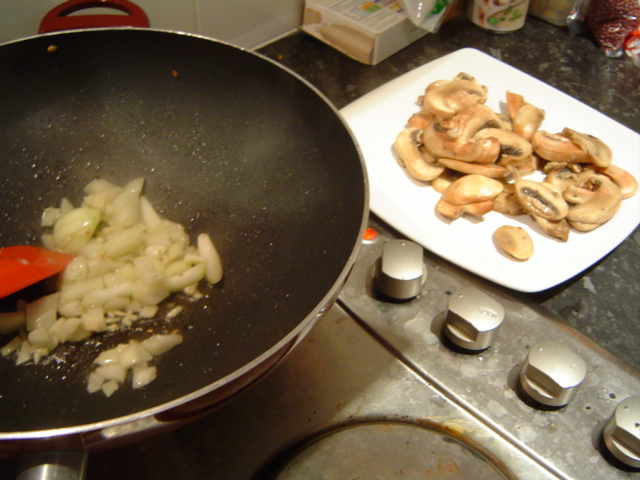
Dice some mushrooms, garlic and onion. Fry the mushrooms until cooked, then set aside. Add more oil to the pan to brown the onions and garlic.


Toast about 3/4 cup of Basics rice in the wok until slightly brown. Add a glass of Basics white wine and continue to stir until the rice has absorbed some of the liquid.


Crumble half (not one as I did) cube of Basics chicken stock into the wok, and slowly add a bit of boiling water at a time until you have up to about 1.5 cups of water in the pan per person. Cover for about 10-15 minutes.


Finally, stir in Basics Italian hard cheese and Blue Cheese and add in the mushrooms. Stir everything together until the entire thing is consistent.


I'm not sure why I ended up with the brown hue as pictured, though I suspect that it's due to the use of the Basics chicken stock cube. Reducing it by half and perhaps using vegetable stock instead would probably result in a better colour, and improve the flavour by not having so much sodium and glutamate. The italian hard cheese, blue cheese and mushrooms also contributed to the glutamate levels in the risotto, resulting in a rather meaty flavour but leaving me very thirsty afterwards. I suspect this can be counteracted by reducing the amount of cheese involved, since the risotto can already hold itself together.

DescriptionPrice per UnitNo. of servingsTrade-up PremiumTrade-up Benefits
British Blue Cheese£6.49/kg~ 200g+£0.86/kgShropshire Blue. Proper Stilton will cost even more.

Saturday, 26 February 2011

Lemon Curd Ice-Cream

I might have mentioned this before, but I love ice-cream.One of the things that I would probably miss about the UK when I leave for good is the regular offers on Haagen-Dazs, Ben & Jerry's, and other premium brands of the frozen confectionery. It is a pity though, that the Sainsbury's Basics range offers few products that would give these brands a run for their money, largely due to the cheap ingredients they use to keep things cheap. The only exception would be the Basics Vanilla & Choc Cones, whose ingredients list more closely resembles something you would find from the more upmarket equivalents. This still leaves a gap in the Basics product line for good ice cream sold in tubs though, and it seems that one has no other choice but to make it from scratch.

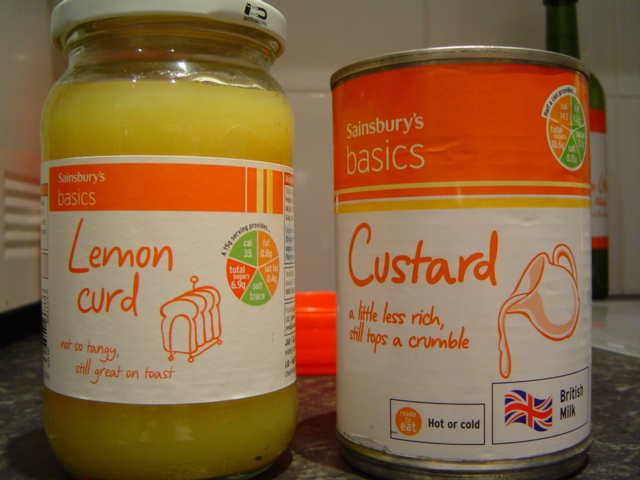
Amongst other sources, I regularly scour the Internet for recipes, looking through culinary blogs to find something that would fit the demanding and unique circumstances that I have to work within. I was reading through thecattylife's ice cream recipe for cookies and cream, when I chanced upon one of the comments made on that post. The comment mentioned a recipe she came across on the MoneySavingExpert forums which merely involves a tin of Basics custard, a jar of Basics lemon curd, and an ice-cream maker.


A brief sanity check validated the recipe: most of the ice-cream recipes on the Internet involved making some form of custard before freezing the contents, so why not use ready-made custard? I don't have an ice-cream maker, but a quick Google search turned up this excellent article written by David Lebovitz showing how to make ice-cream without using a machine. Excited, I made a quick trip to Sainsbury's to pick up the ingredients.


Apparently, lemon curd has been quite popular as a form of dessert spread through the ages in both the UK, with the States catching on through lemon-meringue pie. To be honest, I have not come across lemon curd ice-cream during my various trips taken around the country during the warmer parts of the year, but would most certainly look for it specifically now.


The mixture seems pretty resilient to freezing. I was not disciplined enough to check on it every 30 minutes as prescribed by Lebovitz, only giving it a good whisk once before tumbling into bed. When I checked on it the next morning, the texture still resembled some form of ice-cream.


It tasted pretty strange though prior to freezing, somewhat like Strepsils, although the strangeness was a lot more toned down after freezing. I attribute this to the lemon curd used. Perhaps I could explore using other ingredients to make Basics ice-cream though, like adding rum-soaked raisins to Basics custard before freezing. It's certainly an avenue worth exploring!

DescriptionPrice per UnitNo. of servingsTrade-up PremiumTrade-up Benefits
Lemon Curd£0.22411g+£0.57Less artificial taste?
Related Posts Plugin for WordPress, Blogger...